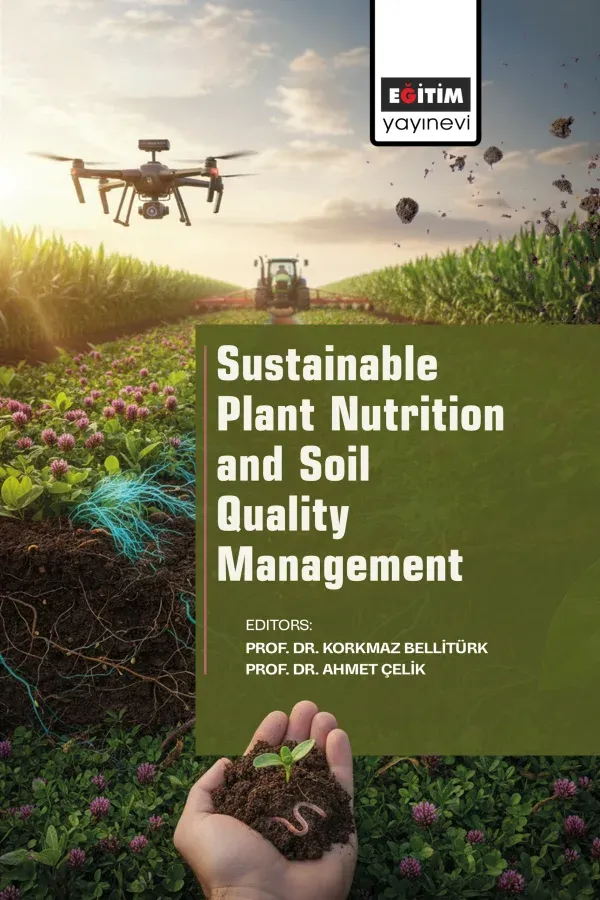
Sustainable Plant Nutrition and Soil Quality Management

This work addresses the achievement of sustainability in agricultural and environmental management by adopting a holistic approach to plant nutrition, soil health, and biological transformation processes. It emphasizes the need to evaluate innovative and science-based production systems in an integrated manner, particularly in response to the resource constraints and environmental pressures confronting conventional agricultural paradigms.
The book demonstrates that sustainable plant nutrition strategies extend beyond yield enhancement, playing a critical role in preserving soil quality, understanding the functions of microorganisms in nutrient cycling, supporting biodiversity, and ensuring long-term agricultural productivity.
The growing importance of microorganisms in organic and sustainable agricultural practices is examined, highlighting from a scientific perspective how atmospheric nitrogen-fixing bacteria and targeted microbial consortia transform plant nutrition processes. Within this context, microbiome engineering in vermicomposting is presented as an innovative approach that enables not only the recycling of organic waste but also its conversion into high value-added, biologically active soil conditioners.
In addition, the book evaluates emerging approaches in modern agriculture, including smart fertilizers, biological inputs, and waste recovery practices, within the framework of environmentally sound and sustainable production systems, using accessible and clear language. The role of urban agriculture and soilless production systems in sustainability is also emphasized, particularly their capacity to enable production in limited spaces and their potential to function as small-scale, income-generating activities. Furthermore, the biological transformation of agro-wastes and the principles of circular production are addressed as complementary components of eco-friendly and sustainable agricultural systems.
In conclusion, this book, prepared with contributions from distinguished scientists from different countries, serves as an interdisciplinary reference focused on sustainable plant nutrition and soil quality. It approaches agriculture not only from a production-oriented perspective but also through its biological, economic, and environmental dimensions. This work offers a holistic and accessible resource for researchers, practitioners, investors, policymakers, and all those interested in sustainable agriculture.
- Açıklama
This work addresses the achievement of sustainability in agricultural and environmental management by adopting a holistic approach to plant nutrition, soil health, and biological transformation processes. It emphasizes the need to evaluate innovative and science-based production systems in an integrated manner, particularly in response to the resource constraints and environmental pressures confronting conventional agricultural paradigms.
The book demonstrates that sustainable plant nutrition strategies extend beyond yield enhancement, playing a critical role in preserving soil quality, understanding the functions of microorganisms in nutrient cycling, supporting biodiversity, and ensuring long-term agricultural productivity.
The growing importance of microorganisms in organic and sustainable agricultural practices is examined, highlighting from a scientific perspective how atmospheric nitrogen-fixing bacteria and targeted microbial consortia transform plant nutrition processes. Within this context, microbiome engineering in vermicomposting is presented as an innovative approach that enables not only the recycling of organic waste but also its conversion into high value-added, biologically active soil conditioners.
In addition, the book evaluates emerging approaches in modern agriculture, including smart fertilizers, biological inputs, and waste recovery practices, within the framework of environmentally sound and sustainable production systems, using accessible and clear language. The role of urban agriculture and soilless production systems in sustainability is also emphasized, particularly their capacity to enable production in limited spaces and their potential to function as small-scale, income-generating activities. Furthermore, the biological transformation of agro-wastes and the principles of circular production are addressed as complementary components of eco-friendly and sustainable agricultural systems.
In conclusion, this book, prepared with contributions from distinguished scientists from different countries, serves as an interdisciplinary reference focused on sustainable plant nutrition and soil quality. It approaches agriculture not only from a production-oriented perspective but also through its biological, economic, and environmental dimensions. This work offers a holistic and accessible resource for researchers, practitioners, investors, policymakers, and all those interested in sustainable agriculture.
Stok Kodu:9786253857509Boyut:160x240Sayfa Sayısı:377Baskı:1Basım Tarihi:Ocak 2026Dili:İngilizce
- Yorumlar
- Yorum yazBu kitabı henüz kimse eleştirmemiş.